


Ask anyone who has tried more than a handful of vegan protein powders and you will hear the same complaints. Chalky. Gritty. Bitter aftertaste. A texture that no amount of shaking or blending fully gets rid of. Some people assume this is just what plant protein tastes like and put up with it. Others give up and go back to whey.
Neither outcome is necessary. The chalky, gritty experience is a product problem, not a plant protein problem. Here is exactly what causes it and what a genuinely good-tasting formula looks like instead.
The reasons most vegan protein powders taste bad
1. The wrong protein source, or a poor-quality version of the right one
Not all plant proteins taste the same, and quality varies enormously within each type. Brown rice protein, for example, is one of the most common plant proteins on the market. It is affordable and available in bulk. It also has a grainy, earthy flavor that is genuinely difficult to work with and a texture that tends to feel gritty regardless of how it is processed.
Even pea protein, which is the best-tasting plant protein source at a technical level, varies significantly in quality. Low-grade pea protein isolate can taste bitter or beany. High-grade organic pea protein isolate, processed properly from the right variety of yellow pea, has a mild, clean flavor that blends smoothly and does not leave residue in the mouth.
The cheapest ingredient is rarely the best-tasting one, and many manufacturers optimize for cost per serving rather than flavor quality.
2. Artificial sweeteners leaving a chemical aftertaste
Sucralose and acesulfame potassium are the two most common artificial sweeteners in protein powder. Both are used because they are extremely sweet at very low quantities, keeping the calorie count down and the sweetness up. Both also leave a distinct aftertaste that many people describe as chemical, metallic, or artificial.
Some people are more sensitive to this than others, but it is one of the most consistent sources of complaints about protein powder taste. The fix is straightforward: use a natural sweetener. Stevia leaf extract, derived directly from the stevia plant, provides clean sweetness with no aftertaste. A small amount is all that is needed.
3. Too many ingredients masking a weak base
When a protein base does not taste good on its own, manufacturers add ingredients to compensate. Flavor enhancers, additional sweeteners, salt to suppress bitterness, and multiple artificial flavor compounds can all layer on top of each other. The result is a formula that tastes busy and artificial rather than clean and natural.
A useful rule of thumb: the more ingredients in a protein powder, the more likely it is that the base ingredient needed help. A powder that tastes good with three or four ingredients is almost always using a better protein source than one that needs fifteen.
4. Inadequate processing
Even with a good protein source, processing matters. Pea protein that has been over-processed or processed with the wrong method can develop off-flavors. Protein that has been stored incorrectly before processing can oxidize and taste stale. These are manufacturing issues that consumers cannot see on the label but notice immediately in the glass.
5. Poor mixability
Chalkiness is often a texture problem as much as a flavor one. Protein powders that do not dissolve fully leave undissolved particles that coat the mouth and throat. This is partly a function of the protein source and partly a function of how the powder is milled and processed. Fine-milled, high-quality pea protein isolate dissolves much more completely than coarser or lower-grade alternatives.
|
The pattern Most bad-tasting protein powders share the same root causes: a cheap or poorly processed protein base, artificial sweeteners that leave an aftertaste, and a long ingredient list added to compensate for both. Fixing the taste means fixing the ingredients, not adding more of them. |
What a good-tasting vegan protein powder actually needs
Solving the taste problem is not complicated, but it requires making the right choices at every step of the formula.
-
High-grade organic pea protein isolate as the base. The quality of the protein source determines the ceiling for taste. Organic pea protein from yellow peas, properly processed, has a naturally mild and slightly sweet flavor that needs very little support.
-
Stevia leaf extract, not artificial sweeteners. A small amount of stevia provides clean, plant-derived sweetness with no metallic or chemical aftertaste. It does not mask the protein base, it complements it.
-
Organic vanilla flavor, not artificial vanilla compounds. Real vanilla extract and organic vanilla flavor have warmth and depth that artificial versions cannot replicate. They also blend more naturally with the pea protein base.
-
Nothing else. No salt to suppress bitterness, no gums to improve texture, no flavor enhancers to prop up a weak base. If the protein source and sweetener are right, the formula does not need the extras.
|
What to look for on the label ✓ Pea protein isolate as the first and ideally only protein source ✓ Stevia or monk fruit as the sweetener, not sucralose or ace-K ✓ Organic vanilla flavor, not artificial flavor compounds ✓ Short ingredient list, ideally fewer than five ingredients total |
How we approached it at Future Kind
When we developed our organic vanilla pea protein powder, taste was as important as nutritional quality. We knew from the start that a powder no one enjoys drinking is not actually useful, regardless of its amino acid profile.
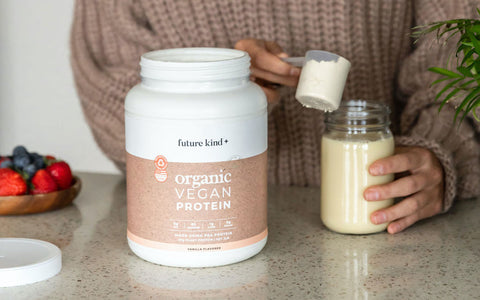
We sourced high-grade organic pea protein isolate from yellow peas, grown and processed to organic and non-GMO standards. We sweetened it with a small amount of stevia leaf extract and added organic vanilla flavor. The ingredient list is four items. That is it.
The result is a shake that is genuinely creamy and satisfying mixed with unsweetened almond milk, and still perfectly drinkable with water. It has a clean vanilla flavor without any chemical aftertaste, and it blends fully without leaving gritty residue. If you want to build on that base, our plant-based protein shake recipes give you a range of options you can use for a simple two-minute post-workout shake or a more substantial breakfast smoothie.
For more on what makes the formula clean beyond the taste, see our guide on what makes a plant-based protein powder actually clean. And if organic certification matters to you specifically, our organic vegan protein powder guide covers what the label actually means and what to look for.
Every batch is independently third-party tested for potency and purity. You can review the results on our product pages before buying.
|
Try Future Kind organic vanilla protein Four ingredients. 20g organic pea protein per serving. Genuinely creamy vanilla flavor. Third-party tested. Made in the USA. → Shop organic vanilla pea protein powder See the full vegan protein range. |
Frequently asked questions
Why does vegan protein powder taste so bad?
The most common causes are a low-quality or poorly processed protein base, artificial sweeteners like sucralose or ace-K that leave a chemical aftertaste, and a long ingredient list added to compensate for a weak formula. The chalky texture is usually a mixability issue caused by coarse protein particles that do not dissolve fully. These are all manufacturing and formulation problems, not inherent properties of plant protein.
Does pea protein taste better than other plant proteins?
High-quality organic pea protein isolate is generally considered the best-tasting plant protein source. It has a mild, slightly earthy flavor that blends cleanly and does not dominate a shake. Brown rice protein tends to be grainier and more earthy. Hemp protein has a stronger, nuttier flavor. Soy protein can taste beany or processed. Pea protein is the easiest to work with from a flavor perspective, which is part of why it has become the most widely used option in clean plant-based formulas.
Is vanilla or chocolate better for vegan protein powder?
Both work well, and the choice comes down to personal preference and how you plan to use the powder. Vanilla is more versatile: it works in both sweet and savoury-adjacent recipes, pairs well with berries and bananas, and is a neutral enough base to add other flavors. Chocolate has a stronger flavor that works particularly well in banana-based shakes and anything with nut butter.
How do you make vegan protein powder taste better?
The single biggest improvement is switching to a powder with a better ingredient list: one with a high-quality protein base and a natural sweetener rather than artificial ones. Beyond that, using plant milk instead of water, adding frozen fruit for texture, and blending properly for at least 30 to 45 seconds all make a significant difference. See our full guide on plant-based protein shake recipes for specific recipes and tips.
Can vegan protein powder be mixed with just water and still taste good?
Yes, if the powder is high quality. A well-formulated vanilla pea protein powder mixed with cold water should produce a clean, lightly sweet shake with no gritty residue or aftertaste. It will be thinner and less creamy than a shake made with plant milk, but it should be perfectly drinkable. If a protein powder tastes bad with water, that is a reliable sign the formula has problems that plant milk is masking rather than solving.


Comments (0)
There are no comments for this article. Be the first one to leave a message!